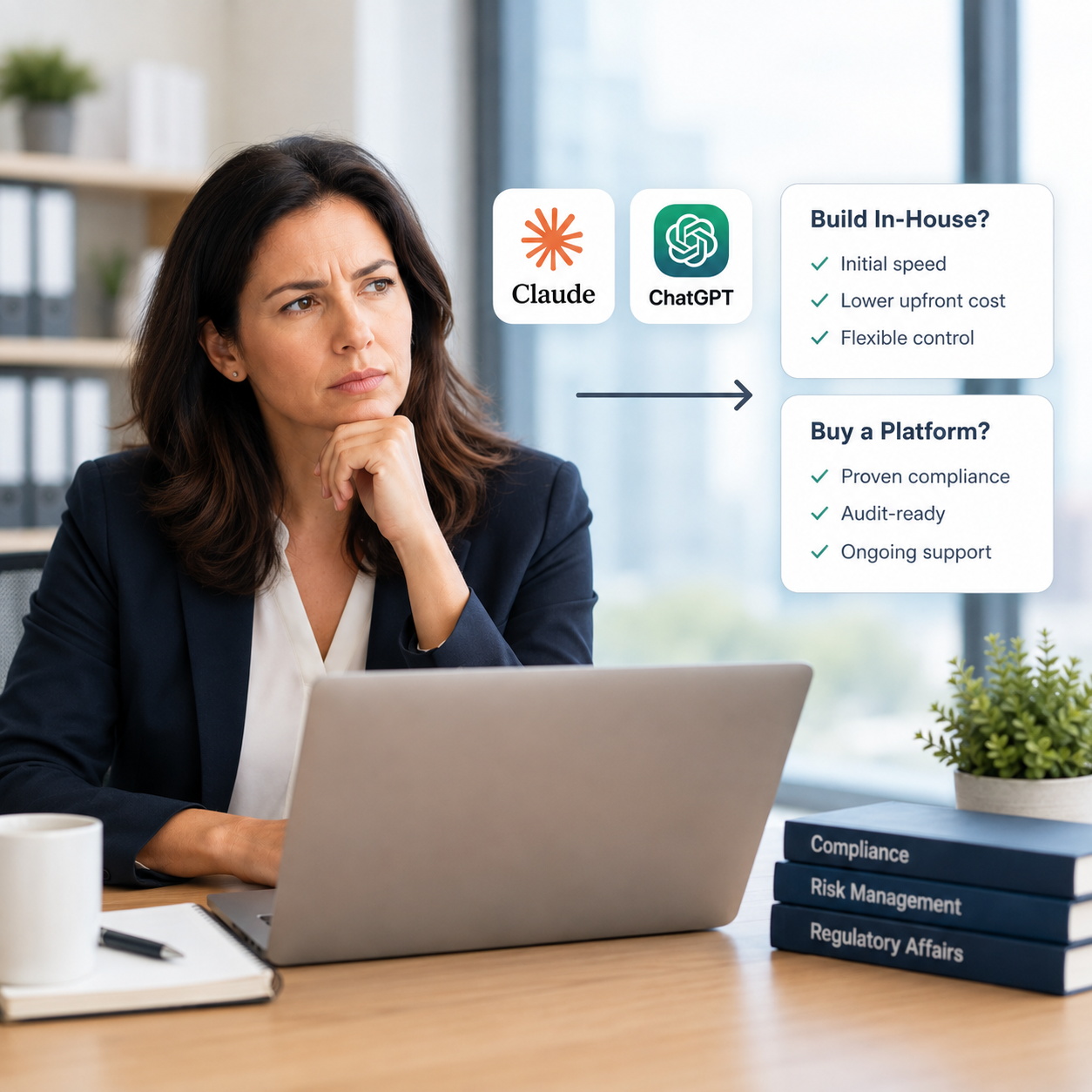
At With Intelligence’s Emerging Managers COO Summit in New York, a roundtable on “buy versus build” quickly evolved into a broader discussion about durability. For emerging managers, infrastructure decisions are not operational footnotes. They are structural choices that influence how the firm withstands scrutiny, absorbs growth, and compounds credibility over time. Systems selected in the first years of a firm’s life often remain in place far longer than expected. Choosing well is not about convenience. It is about resilience.
The discussion ultimately centered on how emerging managers can approach vendor selection as a deliberate risk discipline rather than a procurement exercise. Five principles stood out.
1. Protect Your Alpha: Build What Differentiates You, Buy What Doesn’t
Emerging managers differentiate through strategy, sourcing, portfolio construction, and investor relationships. They do not differentiate by engineering compliance infrastructure or recreating regulatory workflow tools internally.
When a function does not generate alpha or embed proprietary intellectual property, allocating internal development resources toward it deserves scrutiny. Compliance systems, employee certifications, and regulatory documentation processes are operational requirements. They are not competitive moats. Established vendors distribute development costs across multiple clients and evolve alongside regulatory change. Building internally may create a sense of control, but it also concentrates maintenance responsibility and regulatory risk within the firm.
Durability requires discipline in resource allocation. Preserving internal bandwidth for differentiated activities while relying on experienced providers for non-differentiated infrastructure is often the more resilient path.
2. Select a Partner (and a Platform) Built to Scale
Emerging managers evolve quickly. What functions at $150 million AUM must remain effective at $1 billion. Scalability applies not only to the commercial relationship, but to the underlying technology itself.
A vendor relationship should demonstrate flexibility, responsiveness, and access to knowledgeable professionals who understand regulatory realities. Yet relational alignment is insufficient if the platform cannot scale in parallel.
The more substantive questions are structural. Can the system handle increased user volume without performance degradation? Does it accommodate additional entities, strategies, or regulatory complexity without requiring architectural workarounds? Are integrations adaptable as broker relationships expand and reporting requirements deepen?
Early infrastructure decisions should not require wholesale replacement during growth phases. Both the partnership and the technology must be designed to support expansion without friction. Durability depends on it.
3. Balance Innovation with Operational Maturity
Innovation is essential. Obsolescence is a risk. But so is immaturity.
Emerging managers should resist the false binary between legacy systems burdened by technical debt and unproven platforms positioned as transformational. The more disciplined approach lies in the middle: selecting technology that is modern and thoughtfully engineered, yet validated through meaningful real-world use.
A platform weighed down by years of accumulated patches and architectural constraints may struggle to adapt as regulatory expectations evolve. At the same time, newly launched systems without sufficient client adoption introduce a different kind of exposure — operational fragility disguised as innovation.
Durability requires balance. The right partner is not defined by being first to market, nor by having existed the longest. It is defined by having built modern infrastructure that has already been tested across a meaningful number of live environments, regulatory examinations, and scaling firms.
Emerging managers should ask direct questions. How many active clients are operating on the core system? Has it supported firms through regulatory reviews? How frequently is the platform enhanced, and how are updates governed? What safeguards exist if a feature underperforms?
The objective is not novelty. It is resilient modernization. Infrastructure should be architected for the future while proven in the present. That middle ground — modern yet validated — is where operational risk is most effectively mitigated.
4. Evaluate Capital Structure and Incentive Alignment
Vendor ownership is not a superficial detail. It shapes incentives, time horizons, and commercial behavior.
Many technology providers are backed by private equity or venture capital. That capital can accelerate product development and growth, but it also introduces defined return timelines. As valuation targets approach, pressure can manifest through price expansion, bundling strategies, contract rigidity, or aggressive upselling framed as innovation.
For emerging managers, the risk is not simply higher pricing. It is misaligned time horizons. If a vendor’s primary objective is preparing for a liquidity event within a fixed window, long-term partnership dynamics may shift. Product roadmaps can prioritize valuation optics over client stability. Multi-year lock-ins may serve capital strategy more than customer flexibility.
Durability requires understanding those incentives upfront. Firms should ask direct questions about ownership structure, long-term plans, and capital backing. They should negotiate protections accordingly, including clarity around pricing increases, termination rights tied to change of control, and explicit scope definitions.
Not all capital is equal. Ownership structure influences whether a vendor is optimizing for the next funding round or for sustainable partnership over decades. Emerging managers designing durable infrastructure must account for that distinction.
5. Conduct Independent Diligence and Negotiate Deliberately
Vendor diligence should extend beyond curated testimonials. It is prudent to understand how pricing has evolved over time, whether support responsiveness aligns with marketing claims, and what unforeseen costs surfaced post-implementation.
Prime broker consulting teams and compliance advisors often possess broader market visibility than any single reference call can provide. They see implementation outcomes across the ecosystem and can offer context that individual clients may not.
Negotiation itself is part of durability design. Quarter-end timing, referral dynamics, and ecosystem relationships can create leverage that emerging managers underestimate. Vendor selection is not simply a purchasing decision; it is a negotiation over risk allocation and long-term alignment. The firms that ask detailed questions and request structural protections tend to encounter fewer surprises later.
Conclusion
Emerging managers face disproportionate operational scrutiny relative to their size. Institutional allocators increasingly assess infrastructure as part of diligence. Durable systems, documented controls, and scalable compliance processes signal maturity and foresight.
The SEC’s 2026 Examination Priorities reinforce this reality. The Division of Examinations has expressly highlighted a continued focus on smaller firms and advisers that have never been examined or were recently registered. Emerging managers are not flying under the radar. They are increasingly within it. Programs will be evaluated not only on design, but on evidence of execution and supervisory depth.
Designing for durability therefore requires treating vendor selection as strategy. Protect alpha-generating bandwidth. Ensure both platform and partnership scalability. Balance modernization with proven operational maturity. Align incentives by understanding capital structure. Conduct independent diligence.
Infrastructure decisions compound. The managers who approach them with discipline position themselves to scale without disruption — and to withstand scrutiny when it inevitably arrives.