An honest look at what compliance teams actually do during the annual review process, drawn from conversations with compliance officers across the industry, and why firms that document as they go are better off.
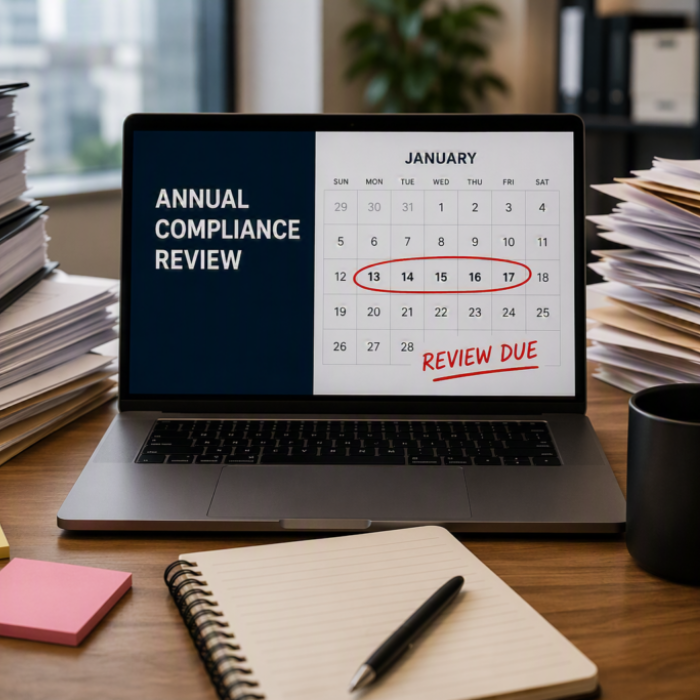
Picture this: The new year is under way and your annual compliance review is due. The problem isn’t that nobody started the document, it’s that the evidence needed to support it lives everywhere: spreadsheets, inboxes, shared drives, HR systems, and someone’s memory. Most teams don’t spend their annual review period writing the review. They spend it piecing the last twelve months together.
Why does the process take so long? Because the proof that policies were followed was rarely captured with annual reporting in mind.
What the Review is Designed to Demonstrate
Under SEC Rule 206(4)-7, its state equivalents, and most internal governance frameworks, the annual compliance review answers four questions:
- Were policies reasonably designed to prevent violations?
- Were those policies followed throughout the year?
- Were any material weaknesses, deficiencies, or gaps identified, and how were they addressed?
- Does the program need to evolve in response to regulatory, business, or operational change?
Each answer needs evidence. Unfortunately, that evidence tends to sit across multiple systems, assuming it was captured at all. So what teams are really doing in Q1 is figuring out whether they can answer these questions clearly, defensibly, and on paper.
Weeks 1- 2: Finding the Evidence
The first thing most compliance teams realize is that there’s no single source of truth. The manual is current. The policies are in place. However, the supporting documentation is scattered. Training attestations for mid-year hires are split between HR and email. Marketing approvals sit in folders stuffed with duplicate versions. Incident tracking may have stopped months ago.
The records usually exist. They’re just hard to retrieve, validate, or report on. So, weeks one and two become a hunt.
At one mid-sized credit manager, the team kept a master Excel log going back years. Their problem wasn’t too little information. It was too much.
The way the logs were formatted, you can’t easily search and retrieve information. And because they go back so many years, there’s just a lot of noise.
Teams pull together training and attestation records, marketing review logs, personal trading certifications, vendor due diligence files, incident documentation, committee minutes, audit trails, regulatory correspondence, and the informal work nobody ever logged. That takes days.
This period is also when firms realize whether the program on paper matches the one running in practice.
Week 3: Assessing What You Have, and What You Don’t
Once the evidence is in, the real analysis begins.
Start with the gap analysis. For every policy, the question is simple: can we prove it was followed, with documentation, not good intentions? The honest answer is often “mostly.” And “mostly” takes judgment. Maybe outside business disclosures were collected, but a few employees never recertified. Maybe marketing reviews were documented through September, went dark until November, and nobody knows whether nothing happened or the process broke.
We’re way too dependent on just remembering. It’s easy to forget the day to day when you’re in the middle of something else.
Then comes the regulatory change inventory. Someone must weigh the year’s developments, new regulatory guidance, shifting electronic-communications expectations, evolving custody requirements, against the policies already on the books. Did anything change that should have triggered an update, but didn’t? This is usually where outside counsel steps in, adding cycles and cost.
Finally, the narrative. The review isn’t a checklist. It’s a story read by regulators, auditors, boards, and leadership. Build it from contemporaneous records and it flows. Build it from a year of disconnected artifacts, and it fights you the whole way.
Week 4+: Reviews, Revisions, and Late-Stage Discovery
By week three, you have a draft. Now the review starts. The CCO circulates it, legal combs the key language, and stakeholders weigh in. Is there a material weakness or control deficiency? Does this finding need more context? Every question can send someone back into step 1: evidence collection.
There’s a hidden cost, too: uncertainty. Did we miss something? Does that issue look worse in writing than it felt at the time? Those aren’t signs of risk. They’re signs you can’t see the whole picture, and that slows everything down.
Writing that memo is a beast. What would save a lot of time is if I could just feed in all the work we did and have someone draft me a first version.
The firms that dread the review most aren’t the ones with the weakest programs. Often, they’re the ones spending Q1 discovering things they should have known all year.
What a Compliance-First System Changes
It comes down to how documentation is handled year-round. Firms that finish in days build processes that create evidence continuously. That’s exactly where Skematic comes in. It unifies firm policies, compliance tasks, employee activities, and case management in one connected system, so the record builds itself as the work gets done.
- Document activity when it happens. Recurring work is scheduled automatically, with evidence capture and timestamps baked in. Certifications are pre-populated and auto tracked. Personal trading flows through direct broker API feeds that backfill gaps on their own. Exceptions open a case in the CCO’s dashboard instantly. By year-end, the review is synthesis, not reconstruction.
- Keep a running regulatory change log. Skematic stores policies in a central library with full version control, so changes flow straight to the tasks, certifications, and obligations that depend on them. Most of the discovery is done long before January.
- Tag as you go. Every obligation maps to the exact policy and regulation behind it, so findings connect to their reporting requirements the moment they’re logged. When the exam arrives, you’re clicking download, not building a binder.
The Bottom Line
The months-long scramble doesn’t mean your team is behind. It means your compliance record is scattered across systems that were never built to talk to each other. As the industry’s first truly integrated compliance management system, Skematic pulls firm oversight, employee code of ethics, and case management into one ecosystem, with a timestamped, exportable audit trail for every completed activity.
The Modern Way to Manage Your Compliance ProgramRequest a Demo