Financial services compliance software is evaluated by compliance officers and used, day to day, by everyone else at the firm. Skematic’s founders spent years on both sides of that gap, first as compliance officers chasing employees to complete certifications, then supporting software where employee confusion was the single largest source of support tickets. That experience is why the employee side of Skematic was designed first rather than last.
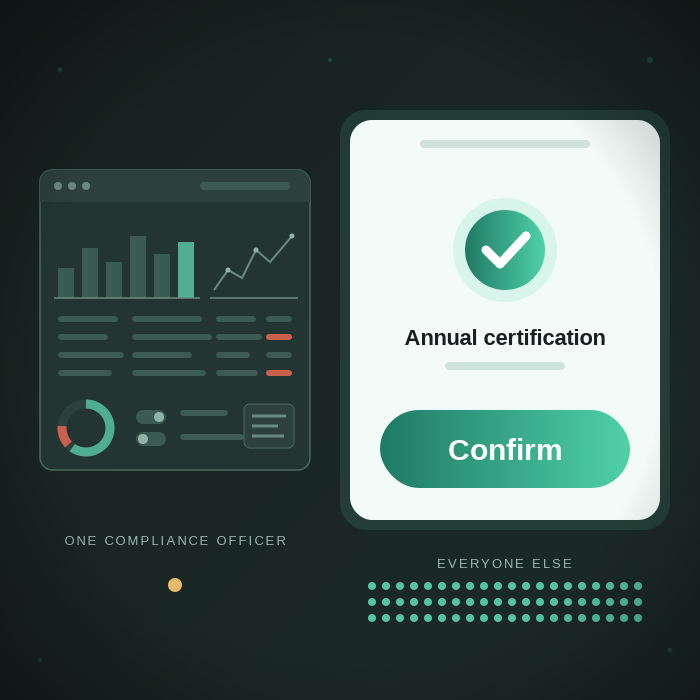
Most compliance platforms are built around the compliance officer’s day. Dashboards, reporting, audit trails, and rules configuration are all necessary, and all of them serve one person in the building. The other audience is the several hundred or several thousand employees who open the system a few times a year, have no particular interest in it, and did not choose it.
Compliance programs rarely fail at the policy level. They degrade at that handoff, because the tools enforcing the policy generate enough friction that people delay, work around them, or click through without reading. A well-written compliance manual does not survive contact with software employees avoid.
What Skematic’s Founders Saw
Brian Kesselman spent years as a compliance officer chasing employees to complete certifications, which is what a difficult system looks like from the operator’s side.
Charles Steerman was employee #2 at Comply. Both founders also spent years supporting employee compliance software, and the same problem surfaced in the support queue. The single largest category of tickets came from employees trying to work out how to use the system. Not compliance officers asking about configuration. Employees who could not complete a task they had been assigned.
That reframes the product question entirely. If the people a compliance program depends on cannot operate the software, the sophistication behind it is beside the point.
Why This Is a Data Quality Problem
Employee experience is easy to categorize as a usability concern, which understates it considerably.
A surveillance engine, a reporting package, and an examination response are only as good as the records underneath them, and those records are produced by employees filling out forms. When the system is painful, completion rates decline, certifications get finished quickly and inaccurately, preclearance requests arrive after the decision has any practical value, and people develop workarounds that leave no trail at all. A sophisticated rules engine processing rushed and incomplete submissions produces confident output from unreliable input, which is a worse position than an obviously incomplete program, because nothing announces the problem.
Meanwhile the compliance officer spends hours pursuing people who would have finished the task if finishing it had been straightforward, and the firm gradually learns that compliance is administrative overhead rather than part of the job.
The reverse compounds in the same way. When a task is quick and hard to get wrong, it gets completed on time and accurately, and the data supporting every downstream function improves. Nobody develops an enthusiasm for compliance. The easiest path simply becomes the correct one.
Designing Around the Second User
Software carries an assumption that more configuration means a more serious product. In compliance, that instinct works against adoption. A system flexible enough to handle every edge case a compliance officer can imagine will expose that flexibility to employees unless someone deliberately prevents it, and an interface that requires concentration to use correctly will be used incorrectly.
So, the employee side of Skematic was designed to look almost comically simple. Large, unambiguous buttons and very little that a person can get wrong. Behind that surface, the engine carries the complexity real compliance programs contain. Building the simple version is the harder engineering problem, because every piece of complexity an employee never sees has to be absorbed somewhere else.
The same reasoning governs support. Employees can contact Skematic directly rather than routing every question through the compliance team, and the person answering is generally a former compliance officer. Both founders had watched the alternative from the vendor side, where an employee question becomes a ticket, and from the compliance seat, where it becomes one more thing the compliance officer is relaying.
Why the Unglamorous Half Got Built First
The employee-facing half of a compliance platform is the half that does not appear in a sales demonstration. It is difficult to show and easy to defer in favor of the compliance officer dashboard that wins deals.
Skematic is part of FRT and The Cross Country Group, a family office that holds its businesses for decades rather than positioning them for sale. Without a timeline running toward a transaction, there is no pressure to ship the demonstration-friendly half and address the rest later. The company is measured on whether firms remain clients over a period of years, and programs employees actually complete are what produces that outcome.
What to Ask For in a Demonstration
Most vendor demonstrations show the compliance officer’s view, because that is who is in the room.
Ask to see the employee view instead. Request a live walkthrough of submitting a preclearance request and completing a certification, performed at the speed an ordinary employee would work rather than by someone who built the screen. Ask what happens when an employee makes a mistake and needs to correct a submission, and whether employees can contact support directly or whether every question routes through the compliance team.
That view is where a compliance program either functions or quietly stops functioning, and it is the part buyers are least often shown.