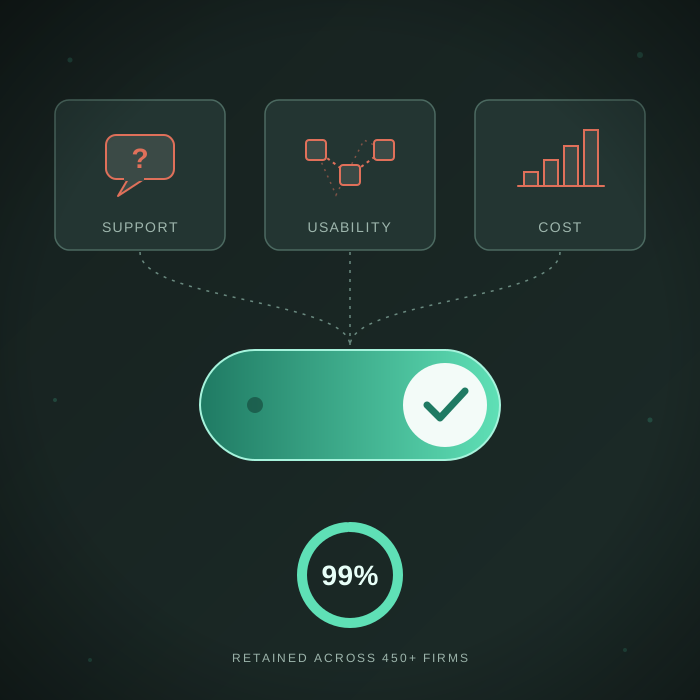
Ask a compliance officer what they think of their current platform and the answer is rarely enthusiasm. Across registered investment advisers, broker-dealers, hedge funds, and private funds, the same three complaints come up: support that cannot answer the question, software that takes more work than it saves, and a price that rises every year without the product changing. Skematic was built against all three, and retains 99% of its customers across more than 450 firms.
In this category, the vendor relationship is frequently the reason firms leave. Switching costs keep teams in place longer than the frustration warrants, so the decision takes years to surface, and when it does it is often about the relationship rather than a missing feature. Support that degraded after an acquisition, an account manager who does not understand the program, a ticket that sat unanswered while a deadline approached: those are the reasons compliance officers give when they finally move. Individually each is tolerable. Together they stop being tolerable, usually during an examination, an audit, or a certification season that goes badly.
The Three Complaints
Support that cannot answer the question.
Most financial services compliance software routes support through a ticketing system staffed by generalists who have never run a compliance program. A question that is part technical and part regulatory, such as whether a preclearance rule is scoped correctly or how to evidence a review ahead of an SEC examination, gets logged and escalated rather than answered. Where a vendor does employ deep compliance expertise, it usually sits in a separate advisory practice that is engaged under a statement of work and billed separately.
Software that creates work instead of absorbing it.
Platforms assembled from separately built modules, whether developed internally over a decade or acquired, share a login without sharing a data model. The compliance calendar has no visibility into case management. Preclearance decisions do not reach trade surveillance without a sync. Every seam between systems becomes a place where the compliance team reconciles by hand, produces the audit trail manually, or discovers a gap after the fact.
A price that rises without the product changing.
First-generation platforms were built for a different technical era, and that architecture carries permanent maintenance overhead. Someone has to keep older broker feed connections and document-processing pipelines running. That cost is real, it does not produce new capability, and it reaches the customer as an annual increase on a product that looks much as it did three renewals ago.
Why the Three Persist
These complaints are durable because they are structural rather than accidental.
Architecture decided fifteen or twenty years ago hardens once a platform has hundreds of paying clients, because replacing a foundation under a live customer base is expensive and risky enough that it rarely gets approved. Consolidation compounds it. Acquisitions bring capability along with separate codebases and data models, and reconciling them competes against every other roadmap priority.
Ownership shapes the rest. Nearly every major platform in this market has taken institutional capital, and both common structures point away from support. Private equity ownership is organized around a hold period and a sale, which rewards margin expansion across a larger base. Venture funding is organized around growth, which directs hiring toward product and sales. Specialist support is the most labor-intensive and least visible function in the business, and it competes against priorities with clearer returns on the relevant timeline.
What Skematic Built Instead
The people who founded Skematic had encountered all three complaints from the inside before they built anything. Charles Steerman was employee #2 at Compliance Science, the company that became ComplySci and now operates as COMPLY, and spent two decades building employee compliance technology. Brian Kesselman ran personal trading compliance as a compliance officer at a hedge fund, reconciling employee trades by hand because the systems in front of him could not do it. That experience shaped three deliberate decisions.
A data foundation before features.
Skematic was built starting with policies, procedures, and the workflow that carries them out, which is where a compliance program actually begins. Preclearance, certifications, trade surveillance, and case management were added on that foundation rather than beside it. A flagged trade opens a case, links to the policy it implicates, and enters the audit trail as one record, with no synchronization step and nothing for the compliance team to maintain.
Modern infrastructure, and the cost structure that comes with it.
Direct API connections to brokers and other systems are more reliable than the file-transfer approaches they replaced, and they are substantially cheaper to operate. A platform that is not funding the upkeep of aging infrastructure has a different cost base, and that difference can reach the customer rather than being consumed internally.
Support staffed by people who have done the job.
Every client is assigned a named contact who is reachable directly and responds within 24 hours. That person is usually a former compliance officer and usually the one who ran the implementation, so a question about a flagged trade or a rule producing too many alerts reaches someone who has reviewed those alerts in a program of their own. Employees at the firm can contact them directly, which keeps the chief compliance officer from relaying tickets on behalf of colleagues.
Outstanding product and one of the best customer service teams that we have worked with over the past 10+ years.
Why the Ownership Matters
Support of that kind is expensive. Former compliance officers command significant salaries, and staffing a front line with them is difficult to justify for a company measured on margin ahead of a transaction.
Skematic is part of FRT and The Cross Country Group, a family office that has held and grown its businesses for decades rather than positioning them for sale. There is no outside sponsor setting a cost target and no timeline running toward an exit. The company is measured on whether compliance teams remain clients over a horizon of years, which is the standard that makes the support model rational rather than aspirational.
The Question Worth Asking
The three complaints are common enough that most compliance officers assume they are simply the cost of buying software in this category. They are not inherent to compliance technology. They are consequences of when a platform was built, how it was assembled, and who it answers to.
Those are all things a buyer can ask about directly, and the answers are more predictive than any feature comparison.